How to Give an Acceptance Speech
This is the twelfth post in Authentalk’s series about how to write subject matter-specific speeches. Call it Appreciatiain.
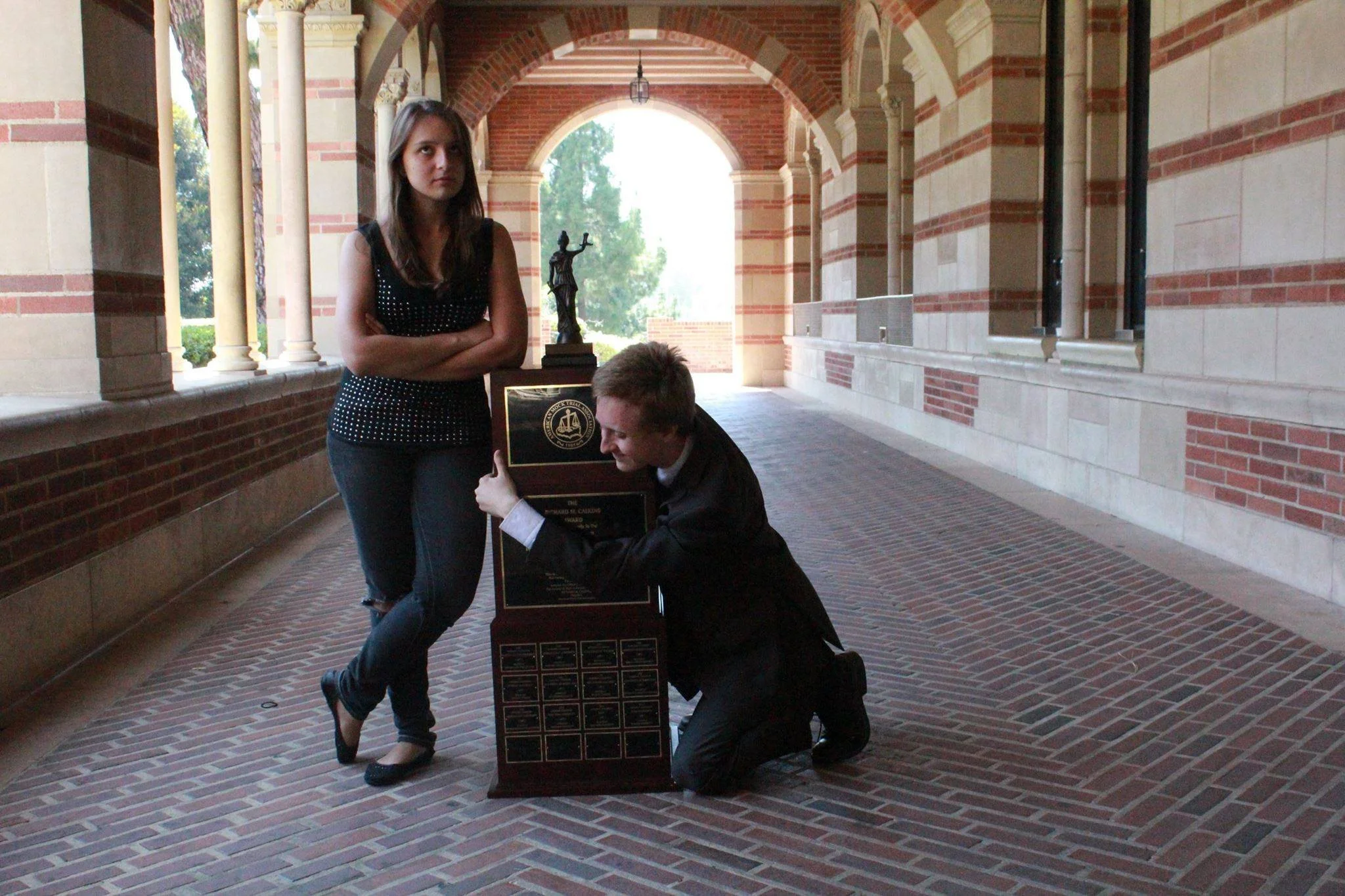
Showing my priorities after winning mock trial nationals in 2014.
Every theater kid has spent a lot of time in front of the mirror, imagining their big moment: they win a Best Actor award, walk to the stage amid rapturous applause, and thank the world for recognizing their talent.
Based on reader analytics, that probably doesn’t match your childhood experience. If you’re reading this blog, you’re likely either an executive from Chicago or Los Angeles, or an undergraduate mock trial competitor who found this page after googling “Iain Lampert.”
I’ve had the honor of giving a number of acceptance speeches. My funniest run was probably in fall 2021, when I made all four final rounds, and took 1st in all four, at the Professional Speech and Debate Association. I had a short 15- to 30-second speech ready to go for each.
I’ve tried to normalize them in the International Public Debate Association’s final rounds: take 30 seconds to express gratitude to the people who helped get you there.
But it’s not as simple as saying thank you. While Dr. Sara Algoe of the University of North Carolina’s research indicates that observing others express thanks builds community and makes them more likely to think the speaker is considerate and trustworthy, UC Santa Cruz research into digital communities contends that certain expressions can be perceived as self-serving or performative.
What’s the right way to say “thank you” in an acceptance speech?
In general, you make an observation about the event, evening, or audience, call out the people who are most responsible for the award, and share a simple, resonant message. You can be as curt as Joe Pesci, who spoke one sentence, or go for up to two minutes. Beyond that isn’t necessary.
But to make an impact, you have to go deeper.
I’d like to share lessons inspired by 10 of my favorite high-profile wins from the Oscars, Emmys, and Tonys.
First, be creative.
Lin-Manuel Miranda won a Tony for his semi-autobiographical In the Heights. He freestyled a speech in rhyming couplets, thanking his collaborators, actors, inspirations, family, and Puerto Rico.
When Ben Affleck and Matt Damon won an Oscar for writing Good Will Hunting, they began with a joke, started with normal thank yous, felt the time pressure, and then leaned into a Laurel and Hardy-style double act, egging each other on and raising the energy of spontaneous gratitude. So wholesome.
Second, focus on the message.
Jharrel Jerome took the climax of his Emmy acceptance speech to share the purpose of his performance: shining a light on the injustice inflicted on the Exonerated Five.
André De Shields earned the right to share some wisdom after decades of theater excellence; he won for Hadestown, one of my top musicals. He acknowledges where he came from, Baltimore, and imparts three lessons in three sentences. We love the rule of three. It helps that he was memorized.
The same year, Rachel Chavkin won Best Direction of a Musical for Hadestown. She gives thanks where it’s due, expresses the theme of the show, and concisely connects it to her key message: racial and gender diversity should be more visible among directors.
When Ali Stroker made history as the first person who uses a wheelchair to win a Tony, she began with her thesis about disability representation and then thanked all her professional and personal supporters.
Third, be true to yourself.
Kieran Culkin won an Emmy for Succession and spent most of the speech thanking his long-term agent, expressing his adoration for his kids, and asking his wife for another child. He didn’t care that his suit jacket fell off. Nobody wants or expects a perfectly polished presentation.
Olivia Colman’s 2019 Oscar acceptance speech is one of the most universally beloved speeches I’ve seen. It is grammatically incoherent, and she repeatedly interrupts herself. But it doesn’t matter because she keeps it brief, says how she feels, and plays into her brand of being adorable and humble.
Hattie McDaniel wasn’t allowed to attend the premiere of the movie in which she starred. She was shamefully forced to sit at a segregated table at the far back of the room. It was 1940. It took her 30 seconds to express her gratitude to the Academy and, through her eloquence, poise, thoughtfulness, and humility, demonstrate how evil and moronic segregation was.
But my personal favorite might be Ke Huy Quan, who returned after decades away from the silver screen. He’s crying and screaming “oh my god” before he’s able to say anything. Then he thanks his mom, reminds us of his biography, connects it to the American Dream, thanks his family and cast in a way that humanizes all of them, especially thanks his wife, and makes it about the audience in a way that never feels polished or fake.
Take some time to visualize your own acceptance speech for your industry award. You have 90 seconds. Who do you thank? What’s your message? How can you make it fun? As always, be true to yourself.