Support Peer Potential Mock Trial
Some of the best American mock trial isn’t happening on American soil.
I’ve been part of the Peer Potential Mock Trial (PPMT) community since 2016. It’s the most prestigious Chinese mock trial competition on earth. Dozens of teams from major cities like Shanghai and Beijing compete alongside students from less-recognized provinces, all in English, using the American Rules of Evidence and American-inspired cases in front of American and Chinese judges.

I’d love for someone to caption this picture out-of-context.
My involvement started in 2016, when Max Wang, a proud Macalester mock trial graduate, nationals-level competitor, co-founder of Stoooges Education, and good friend, reached out for help creating instructional videos. I met some of his associates at UCLA School of Law and filmed lessons on theme, theory, openings, closings, direct, cross, witnessing, and attorney obligations.
In 2017, Max flew Jessica and me to Shanghai to judge the Chinese students’ version of State v. Dawson, the drunk-driving case from my sophomore year of college.
Then came:
2018: an Empire Mock Trial case about prison abuse.
2019: Davis v. Happyland, my freshman-year product-defect case.
2022: PPMT went virtual with State v. Bowman, my senior-year amusement-park felony-murder case.
2023: the wrongful-death case Allen v. Neptune.
2024: the police-misconduct case State v. Riggs.
2025: a very fun take on Home Alone, where the robber sues the kid for excessive force. 2026: Alabama v. Albacore, a twist on My Cousin Vinny, the greatest legal movie of all time, with apologies to Twelve Angry Men.
Flying home last week, I thought it might be useful to demystify PPMT from the judges’ perspective and offer a few pieces of advice to newer teams.
1. Know your judges.
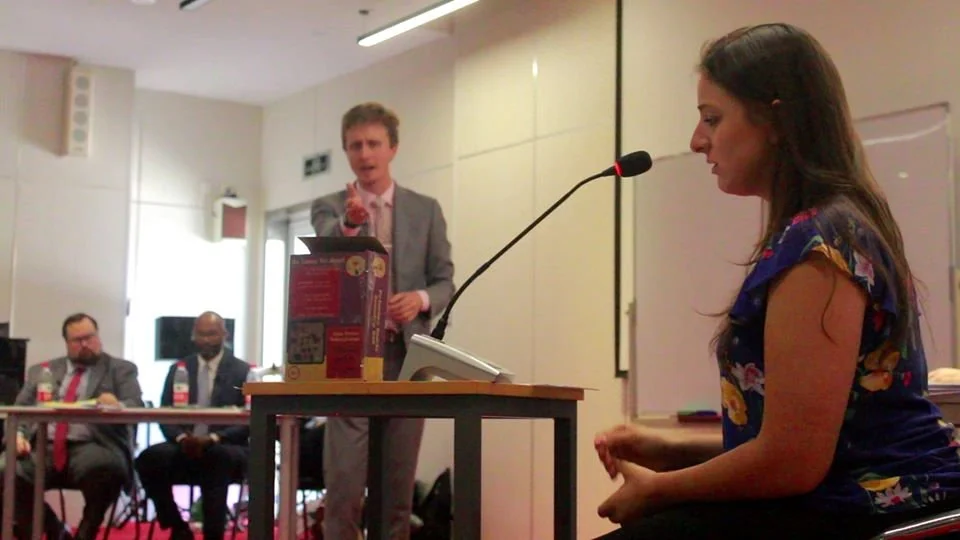
I do a dramatic direct examination of my then-fiancee Jessica. We’re brazenly plagiarizing NYU’s 2011 performance.
Many PPMT judges are alumni who have gone on to undergraduate mock trial, law school, or both. A lot of them also judge year-round for the International Mock Trial League. IMT is famous for giving judges enough time to write detailed ballots with substantial comments. If you can put together an IMT team yourself, do it. If you can’t, post on the mock trial subreddit and find people. At minimum, ask whether you can observe.
2. Know your competitors.
Every year, PPMT publishes videos of its final rounds. Watch them here.
You can see exactly what succeeds at the highest level and what presentational choices the strongest teams make.
For the last four years, the same school, often with many of the same students, has been on a Warriors-style generational run. They win with strong Rules of Evidence knowledge, clean and dramatic presentations, distinct witness portrayals, and aggressive cross-examinations.
You don’t need to copy them. No team is perfect, and the final has repeatedly been a split decision. But you should understand the ecosystem you’re entering. Watch courtroom placement. Volume. Gestures. Witnessing norms. Cross style. How attorneys use space. What judges reward.
3. Know the flow.
PPMT begins with speeches from administrators and Western judges. Write down what they say. If something becomes relevant later, reference it. Show that you were listening.
After Day One, there’s a judge Q&A where students can ask essentially anything. Joe Resnek, one of the greatest trial advocates in AMTA history, laughed with me when he saw how eager the students were to ask questions. He quickly realized what the shrewdest competitors were doing—making a positive impression on people who might judge them later. Even more were taking notes on which judges expressed which preferences so they could adjust accordingly.

This is a funny face, whether it’s in or out of context.
After Day Two comes PP Night, the talent show. This year’s winning team seamlessly referenced a running joke from PP Night during its final rebuttal. Pay attention and loop things back.That’s part of the three WHYs behind a good speech: why me, why you, why now.
And at the end of the competition, the judges put on a showcase round. Learn from it, but learn the right lessons. Some of what we do reflects techniques that can work in normal rounds. Some of it is ridiculous crowd-pleasing nonsense that we would never attempt in front of an ordinary panel. Know the difference. Ask us if you’re unsure.
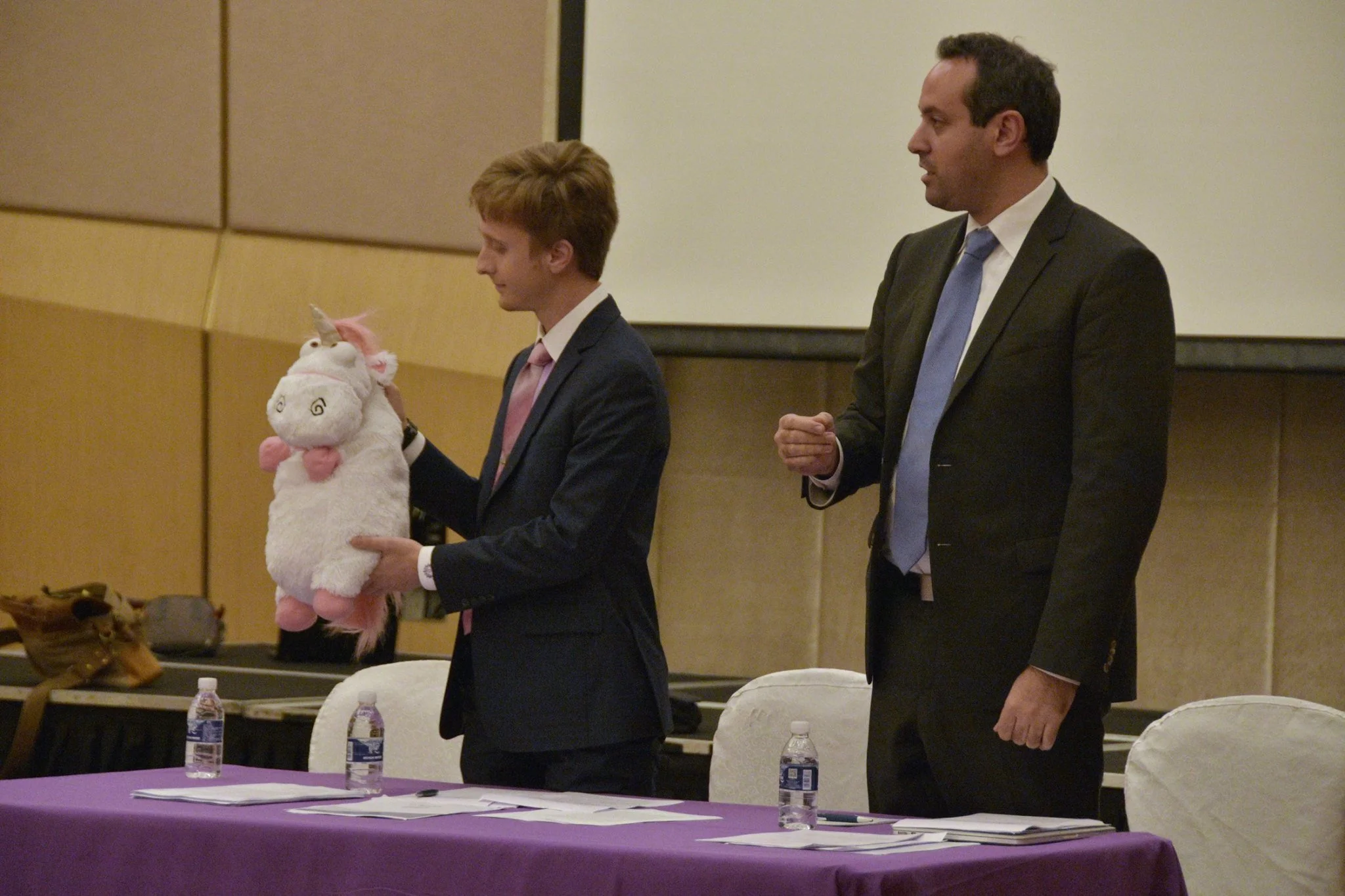
This unicorn represents the defendant.
I am constantly impressed by these students. Language is exceptionally hard for me. I don’t have a great ear for it, as my high school French teacher graciously implied in 2008. I read manga every day and still struggle to remember names longer than three syllables. I spent a month trying to improve my Mandarin, and most of it went in one ear and out the other. My French remains elementary despite years of traveling back and forth to Paris and Canada. So the fact that these overwhelmingly Chinese-born students can perform sophisticated trial advocacy, under pressure, in English, is remarkable.
If you seriously love AMTA, you owe it to yourself to support events like this.
More than one American judge has told me that PPMT gives them hope for the future of international relations. I understand why.
Next year, fingers crossed, I’ll be raising an infant during PPMT, so my chances of attending are probably low. But ask me about it. I’ll happily connect people with the organizers’ WeChat and with the year-round International Mock Trial League, which, importantly, even gives awards for outstanding judges.
Some of the best American mock trial isn’t happening in America, so it’s even more worth paying attention to.
See you whenever Genevieve is ready!